Published by:
CGP EDU Academic Team
Published on: September 12, 2026
Find out
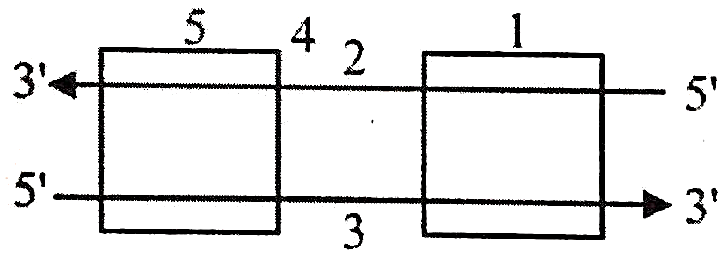
from the given diagram-

A-Promoter site
B-Structural gene
C-Terminator gene
D-Template strand
E-Coding strand
A | B | C | D | E | |
(a) | 5 | 1 | 4 | 2 | 3 |
(b) | 5 | 1 | 4 | 3 | 2 |
(c) | 5 | 4 | 1 | 2 | 3 |
(d) | 1 | 4 | 5 | 2 | 3 |
Text Solution
Verified by ExpertsThe correct answer is:
B
To determine the part of the DNA sequence shown in the diagram based on the options provided, we analyze the structure of DNA. The diagram depicts segments labeled 1 through 5, with the 5' and 3' ends indicated.
1. **Understanding the Options**:
- **Promoter site (A)**: This is the region where transcription starts, but cannot be identified directly in the given diagram without context.
- **Structural gene (B)**: This refers to a sequence that codes for a protein. The segments in the diagram would likely correlate with coding regions.
- **Terminator gene (C)**: This signals the end of transcription.
- **Template strand (D)**: This is the strand used for RNA synthesis during transcription.
- **Coding strand (E)**: This is the strand with the same sequence as the mRNA (except for thymine being replaced by uracil in RNA).
2. **Identifying the Sequence in the Diagram**:
- From a typical DNA sequence diagram, the middle segments numbered 2, 3, and 4 are generally part of the coding region (structural gene), while the segments on the ends may be promoter and terminator sites. In the absence of specific markers, we generally take the central part of the sequence to represent the structural gene.
3. **Conclusion**:
- Given that the segments labeled 2 and 4 are most likely part of a structural gene while considering the arrangement, we conclude the correct answer is structural gene (B). Thus, the answer is B.
1. **Understanding the Options**:
- **Promoter site (A)**: This is the region where transcription starts, but cannot be identified directly in the given diagram without context.
- **Structural gene (B)**: This refers to a sequence that codes for a protein. The segments in the diagram would likely correlate with coding regions.
- **Terminator gene (C)**: This signals the end of transcription.
- **Template strand (D)**: This is the strand used for RNA synthesis during transcription.
- **Coding strand (E)**: This is the strand with the same sequence as the mRNA (except for thymine being replaced by uracil in RNA).
2. **Identifying the Sequence in the Diagram**:
- From a typical DNA sequence diagram, the middle segments numbered 2, 3, and 4 are generally part of the coding region (structural gene), while the segments on the ends may be promoter and terminator sites. In the absence of specific markers, we generally take the central part of the sequence to represent the structural gene.
3. **Conclusion**:
- Given that the segments labeled 2 and 4 are most likely part of a structural gene while considering the arrangement, we conclude the correct answer is structural gene (B). Thus, the answer is B.
Prepare Smarter with CGP Edu
Get practice questions, solutions, and test series in one place.
Write a Review
Share your experience with this question and solution.
Commentary
Send your comment, doubt, correction, or feedback to admin.
Similar Questions
Explore conceptually related problems
Sodium carbonate cannot be used in place of for the identification of and (in group ) during mi…
Consider the following statements about - and -block elements.
(I) The colour of is due to tran…
A translucent white waxy solid on heating in an inert atmosphere is converted to its allotropic fo…
Which of the following compounds will produce on heating?
What is the standard electrode potential for the electrode in solution? (Given: volt,
Which one of the following represents correct order of basic strength?